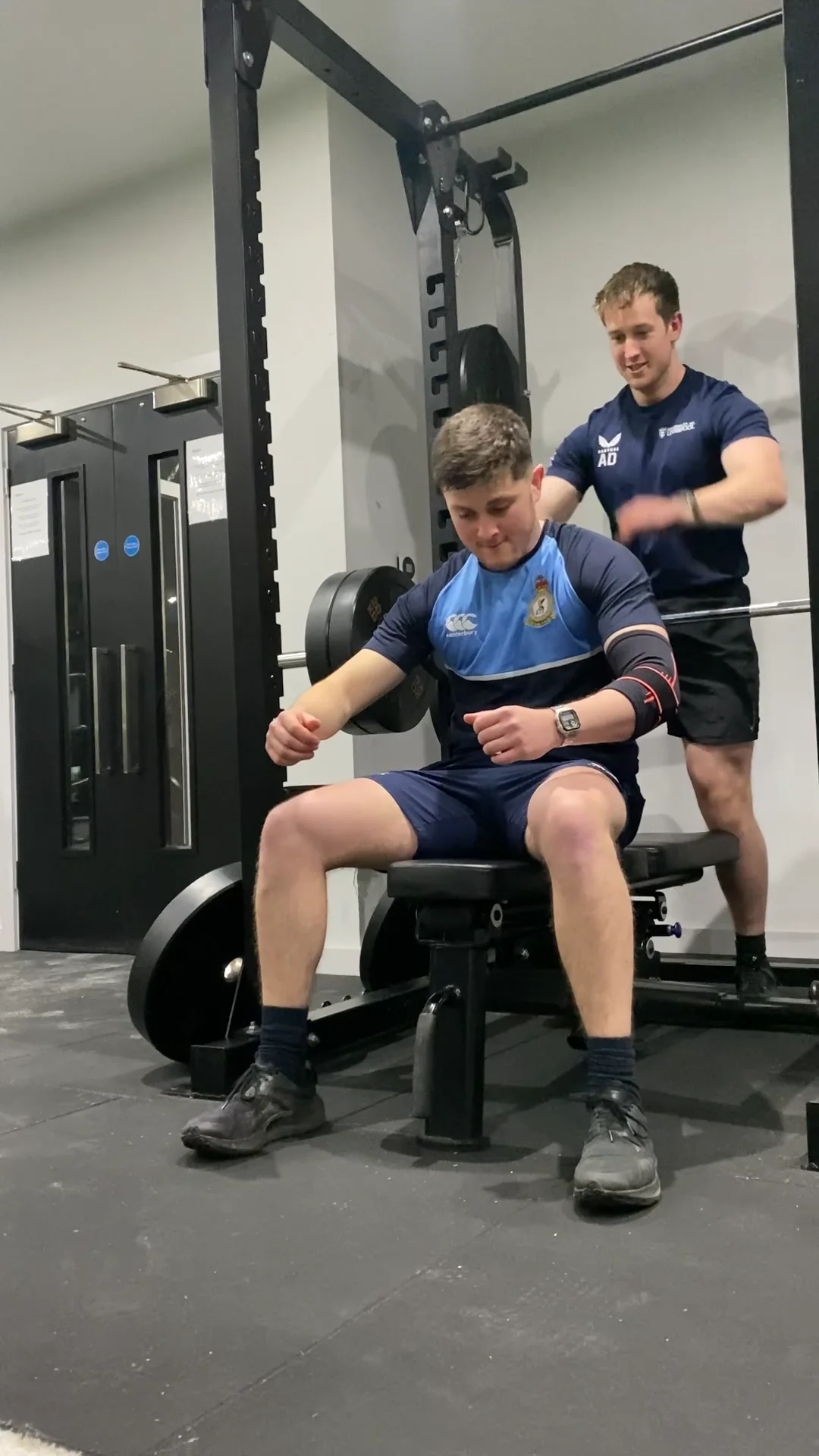
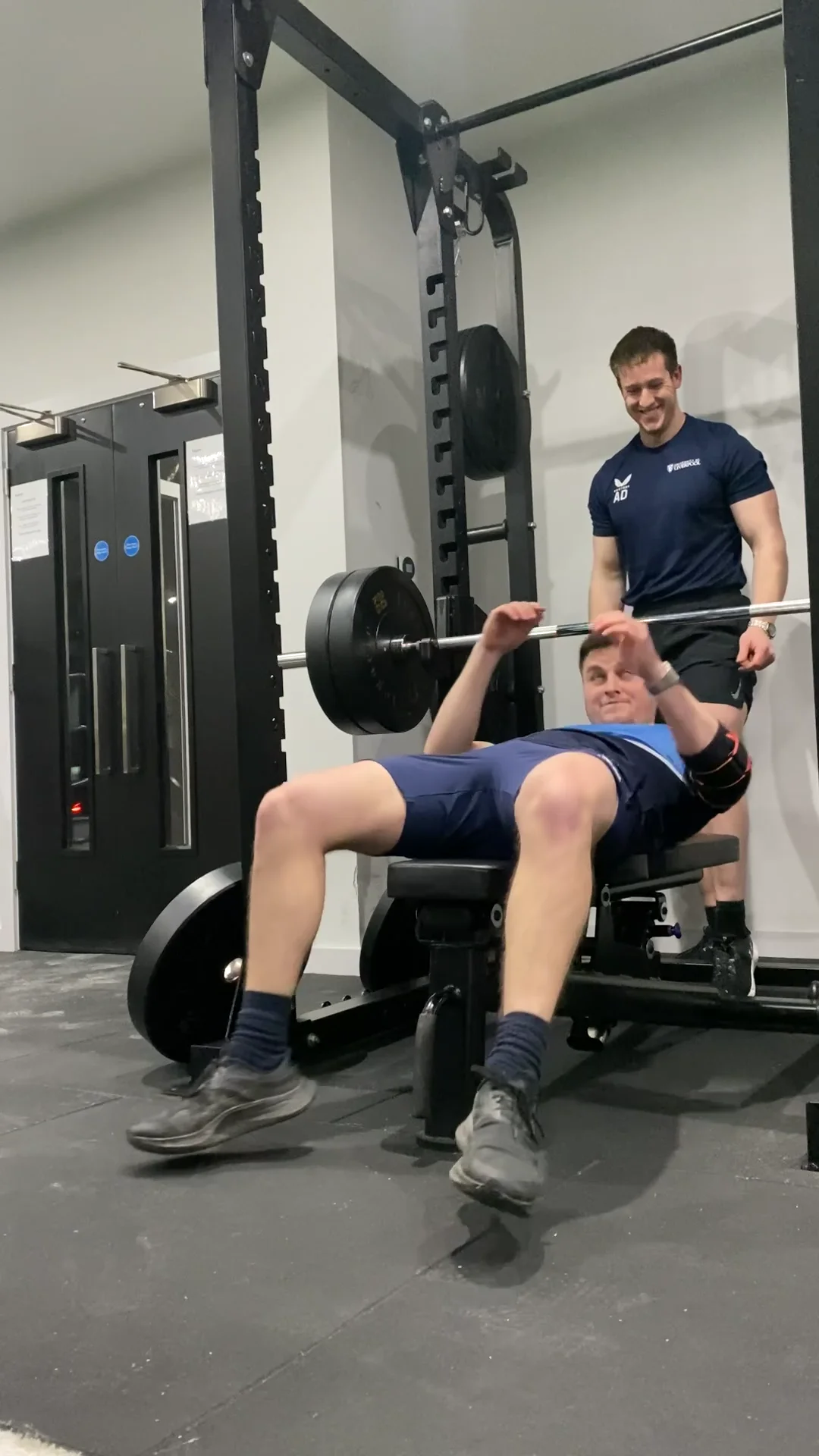

"Couples that train together, stay together." We've all heard that phrase, and it's easy to see some of the obvious benefits: bonding, accountability, or just quality time together. If those claims are true, then I think there's a good argument that it extends beyond just romantic partners. And the research agrees, for the most part.
Don't just take it from me, Arnold has been going on about it for decades. Fifty years after Gold's Gym, he's still writing about training partners in his newsletter. "I have always been a fanatic about training with friends." And: "I was stronger because I trained with friends." Franco Columbu, Dave Draper, Frank Zane. They are the people who pushed him every day. He reckons the usual success story undersells them.
Of course, plenty of strong people trained alone, but that's not to say there isn't value in having someone to train with. So I went and read the research properly, and it turns out training with other people isn't just "more fun." It changes how likely you are to still be training in six months. And in one particular setup, it changes how hard you push in the session itself.
1. Nobody notices when you quit.
The best study on this is rather old, and it isn't really about lifting.
Wing and Jeffery, 1999. 166 people on a weight-loss programme.[1] Some signed up alone. Some signed up with three friends or family. Half of each lot also got a social-support bolt-on; half didn't.
The result?
Recruited alone, standard treatment: 76% finished, and only 24% kept the weight off fully from months four to ten.
Recruited with friends and given social support: 95% finished, 66% maintained fully.
Both groups mostly finished, and that's the less interesting number. The number that matters is what happened four to ten months in, once the programme stopped telling anyone what to do. Alone, one in four still kept the weight off. With friends, two in three.
Why? My guess is it comes down to who's watching. On your own, the drift back is invisible. Nobody clocks the sessions you skip and so there's nothing to explain and no moment where you have to admit anything. With three friends in it too, the standard becomes a shared one. Embarrassment does some of the work and not wanting to be the one who dropped off does the rest.
2. Encouragement doesn't work. Comparison does.
Carron, Hausenblas and Mack, 1996. A meta-analysis of social influence and exercise, covering the lot: important others, family, class leaders, the people you train alongside, and two kinds of group cohesion.[2] They looked at three sorts of outcome: whether people actually exercised, what they thought about exercising, and how they felt about it.
Most of it came out small-to-moderate. Roughly 0.20 to 0.50, if you speak effect-size, but four effects landed in the moderate-to-large range, 0.50 to 0.80: family support and attitudes, important others and attitudes, family support and compliance, and task cohesion and adherence.
Two of the four big effects are about how people feel about training, not whether they do it. Only two of them touch behaviour, and one of those is family support. The other is task cohesion (feeling bound to other people by a shared goal) and it's the only large effect in the whole thing that lands on adherence. Not on liking exercise more, but on turning up.
That distinction is the useful part. It isn't "having friends at the gym" that predicts sticking with it. It's being linked to them through a shared objective. A mate who trains at the same gym? Good. A mate on the same programme who expects you to train on Tuesday? Different beast.
And there's a much cleaner test of this than a thirty-year-old meta-analysis. In 2016 a team at Penn ran 790 students through eleven weeks of exercise classes and randomly dropped them into four groups: a control, one with social support built in, one with social comparison, and one with both.[3] Proper randomised trial, double-blind.
Comparison worked. Support did nothing. The two groups that could see how they stacked up against other people attended roughly 90% more classes. The support condition, the encouraging messages, the team feeling, the bit everyone assumes is the point, came out at an effect size of 0.01. And people in it actually turned up slightly slower than the control group did.
Which is not the comfortable version. Being cheered on isn't what moves you. Being able to see where you sit against others is.
3. Train with someone better than you
There's a finding in psychology called the Köhler motivation gain effect, which you could summarise as "training with a partner makes you work harder."
What Weber and Hertel's 2007 meta-analysis in the Journal of Personality and Social Psychology says is that the less capable person in a pair gets the motivation bump when paired with someone more capable.[4] Two drivers combined: upward comparison, and feeling like your effort actually matters to the outcome. That second one's the important design detail. The effect is strongest in conjunctive tasks, where the group result hangs on the weakest member. Nobody's done until everybody's done. If the strongest person decides the score, the effect mostly vanishes.
A 2023 meta-analysis in Kinesiology Review pooled 19 studies and 1,912 people, all comparing partnered exercise against training alone.[5] The effect came out at g = 0.91, comfortably significant. As I mentioned in section 2, most social influence on exercise lands between 0.20 and 0.50, and the standouts hit 0.80. This clears all of them. In plain terms, the average person training in this setup outworked most of the people training alone, and not just by a bit.
Everyone wants to be the strongest in the group. The research says the best seat is the other one. Being outclassed is the point.
4. Exercise spreads through networks, and not how you'd expect
Aral and Nicolaides, 2017, Nature Communications. Around 1.1 million runners, 359 million km, five years, cross-referenced against daily weather from over 47,000 stations.[6]
The weather is the clever bit. Rain in Chicago stops Chicagoans running but has nothing to do with whether their friend in Boston runs, so any change in the Boston runner that follows has to come through the friendship. That's what turns a correlation into something closer to cause.
The effect: an extra kilometre run by your friends leads you to run 0.3 km more that same day. It fades over the following days.
Now the odd bit. Less active runners influenced more active runners more than the reverse. The explanation is downward comparison. So looking up at someone better can motivate you, but looking down at someone catching you produces competitive behaviour to protect your position, and here that was the bigger effect. Less flattering than the usual story. You're not inspired by your fitter mate. You're rattled by your slower one gaining on you.
There is a range limit. People were moved by friends slightly better or slightly worse than them, not far better or far worse. Someone twice your total is background noise, but someone ten kilos behind you is a threat.
5. The study that disagrees with everything above
Earlier this year a team published the biggest thing anyone has done on this question. 71 studies, around 22,000 people, group-based interventions against individual ones, in Nature Human Behaviour.[7]
Effect on whether people actually moved more: g = 0.086. Not significant. Their conclusion was that both approaches may work and neither is clearly better.
Here's what I think. That meta-analysis is measuring format, not relationship. Sticking twelve strangers in a class together is a group. It isn't three mates on the same programme who'll notice if you don't show up. Everything in sections 1 to 4 says that the specific ingredients matter, a shared goal, contribution that counts, people roughly at your level and generic groupness contains none of them. Read that way, the null result is almost the point: putting people in a room together does nothing on its own.
That's my take, and I'd rather flag that than pretend the paper agreed with me.
The other thing worth knowing is that the same review found group-dynamics interventions, the ones deliberately built to create cohesion rather than just proximity, did separate out on some outcomes. And there's a proper randomised trial behind that: 627 people, randomly assigned to fitness classes either with or without cohesion-building built in, adherence measured at 24 weeks.[8] The cohesion-built groups turned up more, at effect sizes between 0.29 and 0.47.
It's older adults in exercise classes rather than lifters in a gym, so I'm extrapolating again. But it's randomised, it ran for six months, and it's the only study here that directly tests the thing I've been claiming: build the social structure on purpose and people stay.
So what do you actually do with this?
Without pretending any single study settles the debate forever, here's what I'd take from it:
- Training with people you already know changes whether you're still at it months later.
- Shared goal beats casual gym acquaintances. Task cohesion, not just proximity. Being in a group is not the same as being in your group.
- Being able to see where you stand does more than being encouraged. Uncomfortable but well-evidenced.
- Training with someone slightly better than you can raise your effort, if your contribution counts. Otherwise you're just sharing a rack.
- You're influencing your mates more than you think, especially if you're not the strongest one there.
And none of this replaces the boring stuff. Nobody in these papers got strong because they had friends. They got strong because they trained consistently for a long time, with some kind of progression. The social stuff, like competition and accountability, is what makes the consistency stick, but this isn't a shortcut around real work.
Why SYNCT looks the way it does
We built SYNCT because the gym is already social and the apps aren't. People train with mates, dump programmes into WhatsApp, celebrate PRs in the group chat, and then every tracker acts like you're alone in a bunker.
The research above isn't a coat of paint on a product we already had. It's why the product is shaped like this.
Friends exist in SYNCT because task cohesion predicts sticking with it. The feed is just your mates, which is the whole design: someone who knows you notices when you drop off, and a stranger noticing means nothing. The Sync button (one tap to pull a mate's session into your library) is there because being on the same programme is what turns "same gym" into actual cohesion. And we're building challenges that only finish when everyone finishes, rather than a board the strongest person can carry, because the scoring is the part the Köhler work keeps pointing at.
Use SYNCT or don't. Either way, get someone else involved in your training.